
Safety cabinets for the storage of lithium-ion batteries
Lithium-ion storage
Certified lithium-ion battery cabinets
Battery charging cabinets with 90-minute fire protection offer the safest solution for storing modern lithium-ion batteries. Thanks to integrated shelves and a plug-and-play design for direct mains connection, you can not only store your batteries safely but also charge them efficiently at the same time.
Table of Contents
Our battery cabinets for storing lithium-ion batteries
Discover our range of cabinet models for storing lithium-ion batteries
Battery charging cabinets – fire safety and security in battery storage
Lithium-ion batteries have become an integral part of our everyday lives. Lithium-ion rechargeable batteries are being used in an ever-increasing number of products and devices, not only in the private sector but also, in particular, in trades and industrial settings, such as in a wide range of power tools or mobile machinery. However, these high-performance rechargeable batteries pose significant risks if handled or stored incorrectly. A technical fault, mechanical damage or overcharging can lead to an uncontrolled fire that is very difficult to extinguish. Due to this high risk, the utmost care must be taken to ensure maximum safety when storing and charging lithium-ion batteries.
Our certified lithium-ion battery cabinets offer your business reliable protection against fire hazards. With our tested systems, you not only safeguard your business, but also effectively protect your staff from the consequences of a battery fire.
Battery charging cabinets – fire safety and security in battery storage
Lithium-ion batteries have become an integral part of our everyday lives. Lithium-ion rechargeable batteries are being used in an ever-increasing number of products and devices, not only in the private sector but also, in particular, in trades and industrial settings, such as in a wide range of power tools or mobile machinery. However, these high-performance rechargeable batteries pose significant risks if handled or stored incorrectly. A technical fault, mechanical damage or overcharging can lead to an uncontrolled fire that is very difficult to extinguish. Due to this high risk, the utmost care must be taken to ensure maximum safety when storing and charging lithium-ion batteries.
Our certified lithium-ion battery cabinets offer your business reliable protection against fire hazards. With our tested systems, you not only safeguard your business, but also effectively protect your staff from the consequences of a battery fire.
Certified safety: Battery charging cabinets with 90 minutes’ fire protection
Our lithium-ion battery cabinets offer certified fire safety to the highest standards. You own a Fire resistance of 90 minutes both from the outside in and from the inside out. Depending on the model, this is in accordance with DIN EN 1363-1, EN 14470-1 or VDMA 24994 tested and certified. In the case of the premium model, which has been tested in accordance with VDMA 24494, should a Thermal Runaway further prevents flames, projectiles and splinters from escaping from inside the cabinet, thereby minimising the risk to people.
The greatest risk associated with handling lithium energy storage devices is what is known as Thermal Runaway. This is an uncontrollable chemical chain reaction within the battery cell. Triggered by causes such as overheating during charging, incorrect chargers, overcharging, deep discharge, high ambient temperatures or mechanical damage, the internal temperature rises rapidly. As a result, the battery catches fire, releases toxic gases or, in the worst-case scenario, explodes.
Important: As soon as a Thermal Runaway Once a fire has started, it can no longer be stopped by conventional means. This is precisely where our safety concept comes into play. Only by using certified fire-resistant cabinets and safe charging solutions can the unforeseeable hazards in the workplace be effectively contained, controlled or reduced.
Certified protection during the charging and storage of lithium-ion batteries
As lithium-ion batteries are to be regarded as hazardous substances, and both property insurers and accident insurers consider fire-resistant areas, amongst other things, to be a basic requirement for the storage and charging of lithium-ion batteries, we are firmly committed to maximum protection and offer only cabinets with a fire resistance rating of over 90 minutes. Our solutions therefore provide you with protection in both respects in the event of an emergency:
-
- Protection from the outside in: In the event of a workshop or warehouse fire, fire resistance of over 90 minutes is provided in accordance with DIN EN 14470-1 (for the Safe Pro model), DIN EN 1363-1 (for the Basic model) or VDMA 24994 (on the Premium model) ensures that the heat remains outside and that an external fire does not immediately spread to the interior of the cabinet, thereby preventing a dangerous thermal runaway of the stored batteries.
- Protection from the inside out: Should a battery in the cabinet catch fire uncontrollably, the Premium model offers additional safety. It has been successfully tested in accordance with the strict standard VDMA 24994:2024-08 thermal runaway (Thermal Runaway) tested from the inside. The Basic and Pro models offer 90 minutes’ fire resistance in accordance with DIN EN 1363-1, ensuring that any fire does not immediately spread throughout the room.
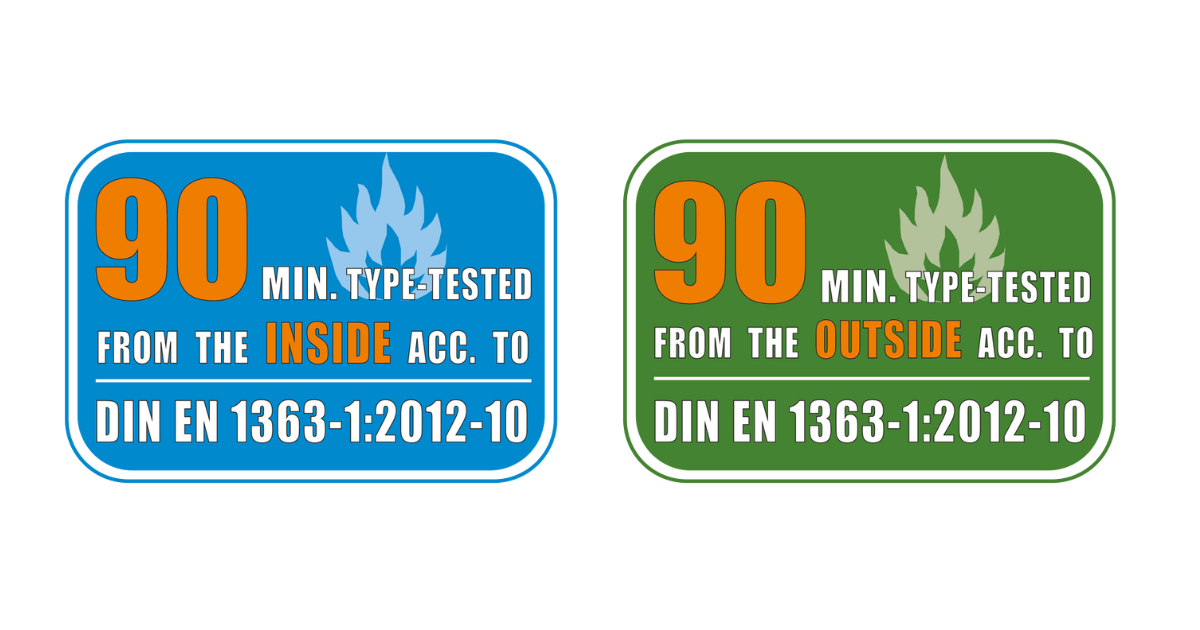
The purpose of fire protection on both sides is to give the emergency services and the fire brigade time to carry out fire-fighting operations and to evacuate people.
This guarantees additional security GS mark of the model Safe Pro (tested in accordance with MPA Dresden, test procedure EK5/AK4 22-01)

Models of our lithium-ion battery cabinets
Our range of lithium-ion battery cabinets, available in various models, offers reliable fire protection for your business
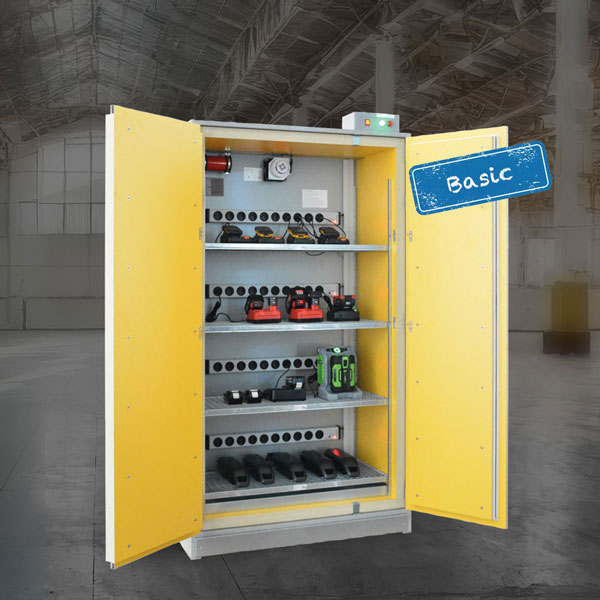
Li-Ion Basic Store / Charge Ei 90 Battery Cabinet
An entry-level model for the active and passive storage of lithium-ion batteries (rechargeable batteries), with a primary focus on fire safety
-
Fire resistance on both sides (EI 90): In the event of an emergency, the cabinet guarantees 90 minutes’ protection in both directions. It effectively prevents external fires from reaching the interior and safely contains any potential battery fire inside
-
Control unit with smoke detection: The integrated control unit constantly monitors the interior of the battery cabinet
- Secure locking system: Smooth-opening double doors that can be locked using a double-bit cylinder lock
- Includes a potential-free contact for signal transmission, e.g. to a control centre
- Retrofitting of customer-supplied fire detectors is possible, thanks to the fire-resistant cable entries fitted in the cabinet

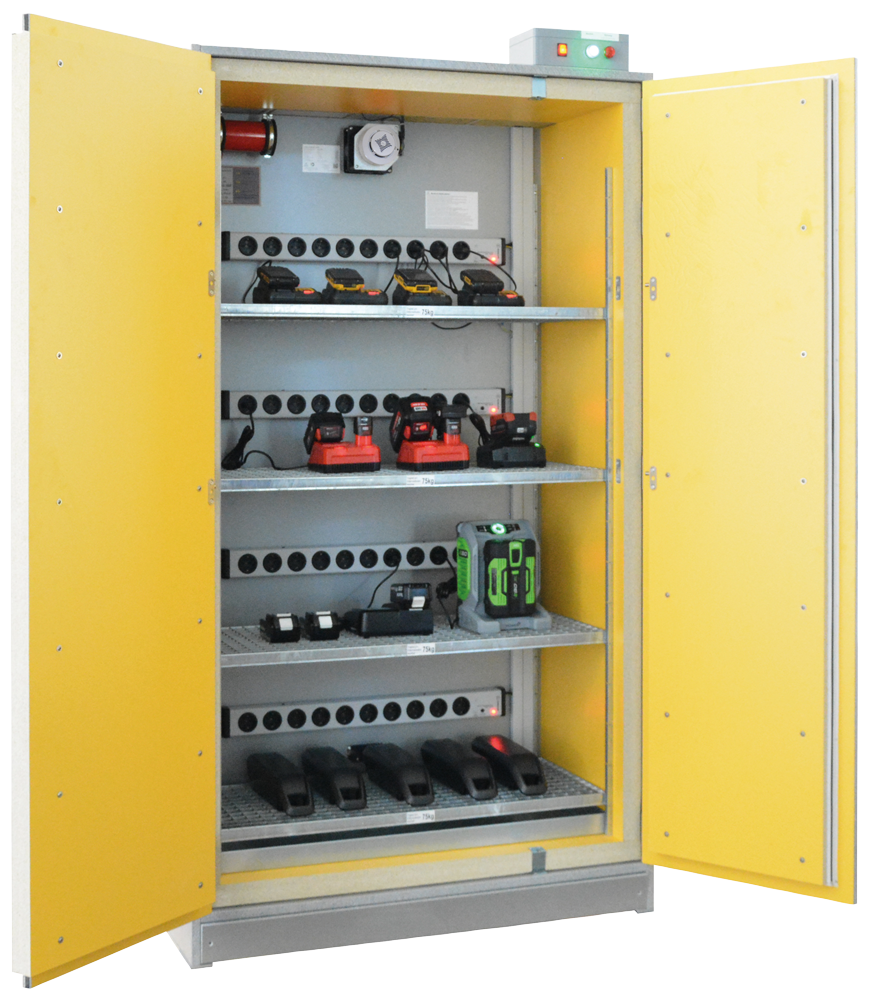
Li-Ion Basic Store / Charge Ei 90 Battery Cabinet
An entry-level model for the active and passive storage of lithium-ion batteries (rechargeable batteries), with a primary focus on fire safety
-
Fire resistance on both sides (EI 90): In the event of an emergency, the cabinet guarantees 90 minutes’ protection in both directions. It effectively prevents external fires from reaching the interior and safely contains any potential battery fire inside
-
Control unit with smoke detection: The integrated control unit constantly monitors the interior of the battery cabinet. As soon as the highly sensitive smoke detector detects the first signs of gas or smoke, the system triggers an alarm and can immediately forward the signal to the building management system
-
Secure locking system: Smooth-opening double doors that can be locked using a double-bit cylinder lock
-
-
Retrofitting of customer-supplied fire detectors is possible, thanks to the fire-resistant cable entries fitted in the cabinet
Features | The LaCont Li-Ion Basic Store / Charge Ei 90 battery cabinet
- Certified complete structure with a fire resistance rating of 90 minutes inside and outside (EI 90)
- Constructed from non-combustible building materials (Class A2 – s1, d0 in accordance with DIN EN 13501-1), including a finish (body in aluminium colour / doors in RAL 1023 – traffic yellow)
- Perimeter fire protection seals that automatically foam up in the event of a fire
-
Doors lockable with a double-bit cylinder lock
-
Integrated ventilation system with smoke detector and fan
-
Fire-resistant cable entries at the top and bottom
-
Smooth-opening doors, 180° opening angle, non-self-closing
-
Base with space underneath, height 100 mm, with removable base panel
-
Storage levels provided by height-adjustable grating, load capacity 75 kg per shelf
-
Control unit with fire detection for Basic Charge EI 90:
Fault notification via an optical signal and shutdown of the ventilation system -
Optional fire suppression system with power-independent activation in the event of a fire or an unauthorised rise in temperature
Control unit for the SiS Li-Ion Basic Charge EI 90
- Power switch
- Visual status indicator
- Automatic switch-off of the fan integrated into the cupboard in the event of smoke detection
- No automatic power cut-off
- No standard audible alarm in the event of a fire – fire detectors can be retrofitted by the customer, thanks to the fire-resistant cable entries in the cabinet
- Includes a potential-free contact for signal transmission, e.g. to a control centre
- Operating voltage 230 volts
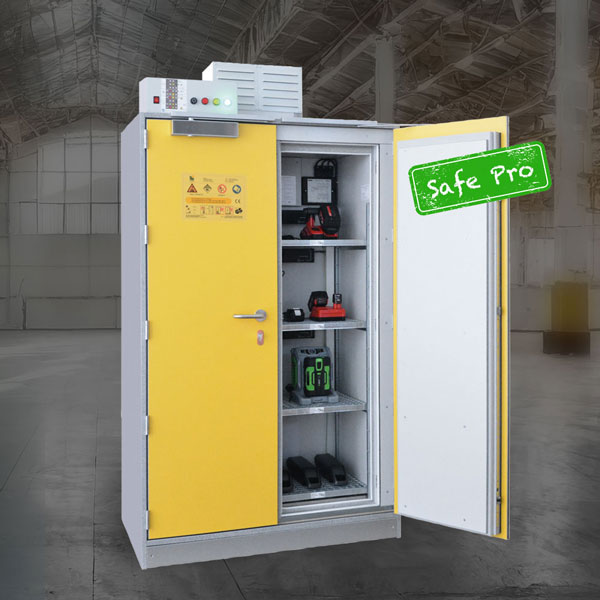
Battery cabinet Li-Ion Safe Pro
A Pro model specially developed for the active and passive storage of lithium-ion batteries (rechargeable batteries), with GS certification in accordance with test principle EK5 / AK4 22-01 and having undergone a real-fire test at MPA Dresden on the cabinet fitted with lithium-ion batteries (rechargeable batteries)
-
Certified fire protection (Type 90): Guaranteed 90 minutes’ protection from the outside in, in accordance with DIN EN 14470-1, and from the inside out, in accordance with DIN EN 1363-2
- GS mark from MPA Dresden
-
Self-closing doors: The double doors have been tested for long-term functionality in accordance with DIN EN 16121 and DIN EN 16122
-
Control unit with fire detection: If a fire is detected inside the cabinet, the power supply and the integrated ventilation system are switched off completely
-
Null-potential contact for signal transmission: For forwarding alarms to a control centre (e.g. fire alarm control panel)
-
Includes cable preparation (inside and outside) for the subsequent installation of a customer-supplied fire alarm to be connected to a fire alarm system

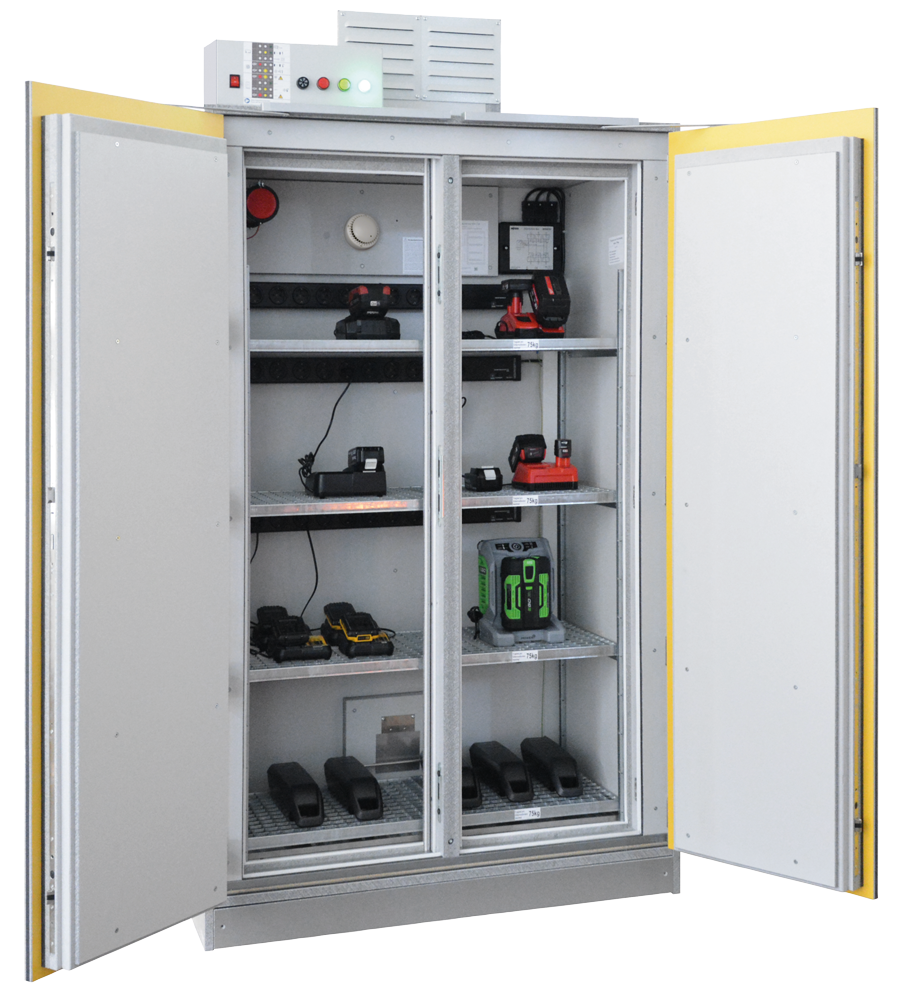
Battery cabinet Li-Ion Safe Pro
A Pro model specially developed for the active and passive storage of lithium-ion batteries (rechargeable batteries), with GS certification in accordance with test principle EK5 / AK4 22-01 and having undergone a real-fire test at MPA Dresden on the cabinet fitted with lithium-ion batteries (rechargeable batteries)
-
Certified fire protection (Type 90): Guaranteed 90 minutes’ protection from the outside in, in accordance with DIN EN 14470-1, and from the inside out, in accordance with DIN EN 1363-2
- GS mark from MPA Dresden
-
Self-closing doors: The double doors have been tested for long-term functionality in accordance with DIN EN 16121 and DIN EN 16122
-
Control unit with fire detection: If a fire is detected inside the cabinet, the power supply and the integrated ventilation system are switched off completely
-
Null-potential contact for signal transmission: For forwarding alarms to a control centre (e.g. fire alarm control panel)
-
Includes cable preparation (inside and outside) for the subsequent installation of a customer-supplied fire alarm to be connected to a fire alarm system
Features | The LaCont Li-Ion Safe Pro battery cabinet
- Tested fire resistance of 90 minutes in accordance with DIN EN 14470-1 from the outside in
- Tested fire resistance of 90 minutes from the inside out, in accordance with DIN EN 1363-2
- GS mark from MPA Dresden audited in accordance with the audit principles EK5 / AK4 22-01
- Tested smoke-tightness
- Self-closing doors, tested for long-term functionality in accordance with DIN EN 16121 and DIN EN 16122
- Constructed from non-combustible materials, including a coating (body in RAL aluminium colour / doors in RAL 1023 – traffic yellow)
- Perimeter fire protection seals that automatically foam up in the event of a fire
- Double-leaf door with a central mullion, lockable with a profile cylinder lock; cupboard doors close automatically
- Includes technical ventilation (to prevent heat build-up inside the cabinet)
- Base with space underneath, height 100 mm, with removable base panel
- Storage levels with height-adjustable mesh shelving, load capacity 75 kg per level
- Includes floor tray in accordance with AwSV, powder-coated sheet steel in RAL 7035 – light grey, capacity 5 litres
- Each grating level can be fitted with a power strip featuring 10 earth-connected sockets
- Equipped as standard with a control unit (visual and audible status indicators), fire detection and smoke detectors
- Complete disconnection of the power supply to the cabinet in the event of an emergency
- Surge protection
- Operating voltage 230 V or 400 V (the version without a power strip is available in 230 V only)
Control unit of the SiS Li-Ion Safe Pro
- Power switch
- Visual status indicator
- If a fire is detected inside the cabinet, the power supply and the integrated ventilation system are switched off completely
- If a fire is detected, a visual and audible alarm is triggered
- Includes a potential-free contact for signal transmission (e.g. to a control centre)
- Includes cable preparation (inside and outside) for the customer to retrofit a fire alarm sensor, for connection to a fire alarm system
- Optional GSM module for remote monitoring and alarm notification
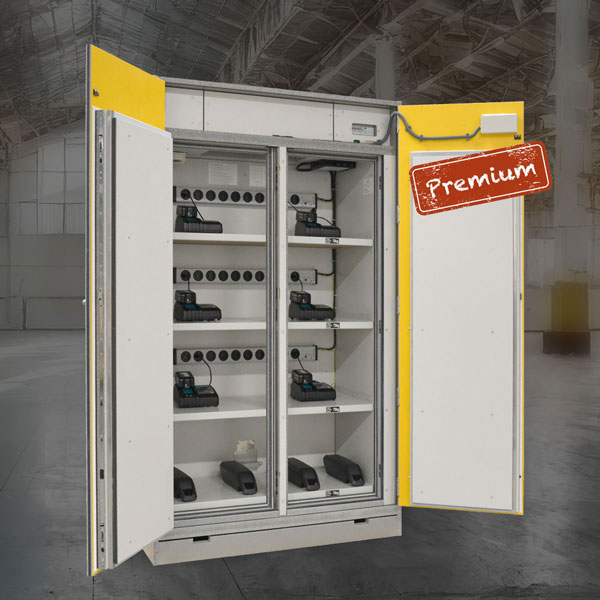
Li-Ion Premium Battery Cabinet
Premium model specially designed for the storage and charging of lithium-ion batteries (rechargeable batteries), successfully tested in accordance with VDMA 24994, tested for thermal runaway from the inside and fire resistance of > 90 minutes from the outside inwards
- VDMA-certified fire protection: Successfully tested in accordance with the latest directive VDMA 24994:2024-08 against Thermal Runaway from the inside and with the highest level of protection from the outside
- Door-open monitoring: The self-closing double-leaf doors emit an audible signal if they remain open for 60 seconds
- Maximum charging power with cut-off: Supports high-power 400 V connections (up to 10.5 kW)
- Null-potential contact for signal transmission: For direct alarm forwarding to an external control centre
- Includes cable preparation (inside and outside) for the subsequent installation of a customer-supplied fire alarm to be connected to a fire alarm system

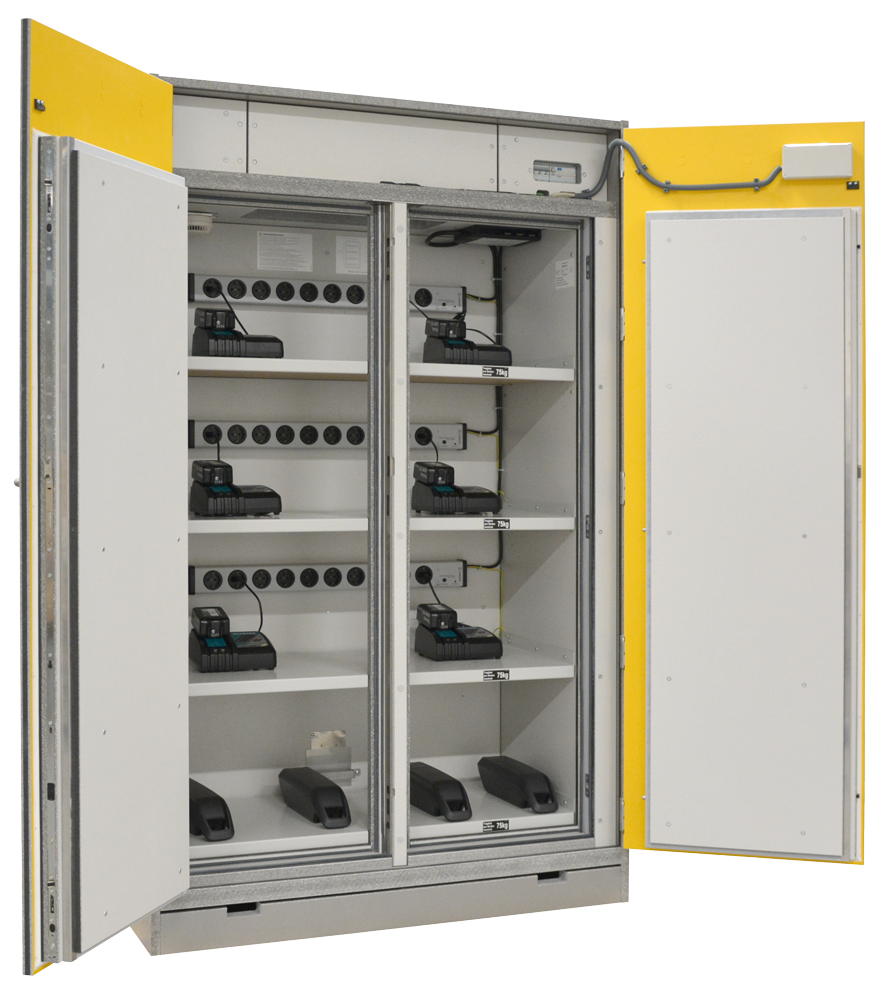
Li-Ion Premium Battery Cabinet
Premium model specially designed for the storage and charging of lithium-ion batteries (rechargeable batteries), successfully tested in accordance with VDMA 24994, tested for thermal runaway from the inside and fire resistance of > 90 minutes from the outside inwards
- VDMA-certified fire protection: Successfully tested in accordance with the latest directive VDMA 24994:2024-08 against Thermal Runaway from the inside and with the highest level of protection from the outside
- Door-open monitoring: The self-closing double-leaf doors emit an audible signal if they remain open for 60 seconds
- Maximum charging power with cut-off: Supports high-power 400 V connections (up to 10.5 kW)
- Null-potential contact for signal transmission: For direct alarm forwarding to an external control centre
- Includes cable preparation (inside and outside) for the subsequent installation of a customer-supplied fire alarm to be connected to a fire alarm system
Features | The LaCont Li-Ion Premium I/O 90 battery cabinet
- Tested fire resistance of 90 minutes in accordance with VDMA 24994, from the outside in
- Tested for thermal runaway from the inside out VDMA 24994
- Successfully tested to prevent batteries from catching fire inside; the escape of flames, projectiles and shrapnel is reliably prevented
- The maximum energy capacity of the batteries in storage or to be charged is 8 kWh per cupboard (as demonstrated in a real-world test)
- Constructed from non-combustible materials, including a coating (body in RAL aluminium colour / doors in RAL 1023 – traffic yellow)
- Perimeter fire protection seals that automatically foam up in the event of a fire
- Double-leaf door with a central mullion, lockable with a profile cylinder lock
- Double-leaf door without a self-closing mechanism; an audible signal sounds 60 seconds after the doors are left open
- Includes technical ventilation (to prevent heat build-up inside the cabinet)
- Base with space underneath, height 100 mm, with removable base panel
- Shelf levels are height-adjustable; load capacity 75 kg per level
- Includes floor tray in accordance with AwSV, powder-coated sheet steel in RAL 7035 – light grey, capacity 5 litres
- Each storage level can be fitted with a power strip with 10 earth-connected sockets
- Equipped as standard with a control unit (visual and audible status indicators), fire detection and smoke detectors
- Complete disconnection of the power supply to the cabinet in the event of an emergency
- Surge protection
- Operating voltage 400 V
Control unit for the SiS Li-Ion Premium I/O 90
- Visual status indicator
- If a fire is detected inside the cabinet, the power supply and the integrated ventilation system are switched off completely
- If a fire is detected, a visual and audible alarm is triggered
- Includes a potential-free contact for signal transmission (e.g. to a control centre)
- Includes cable preparation (inside and outside) for the customer to retrofit a fire alarm sensor, for connection to a fire alarm system
- Optional GSM module for remote monitoring and alarm notification
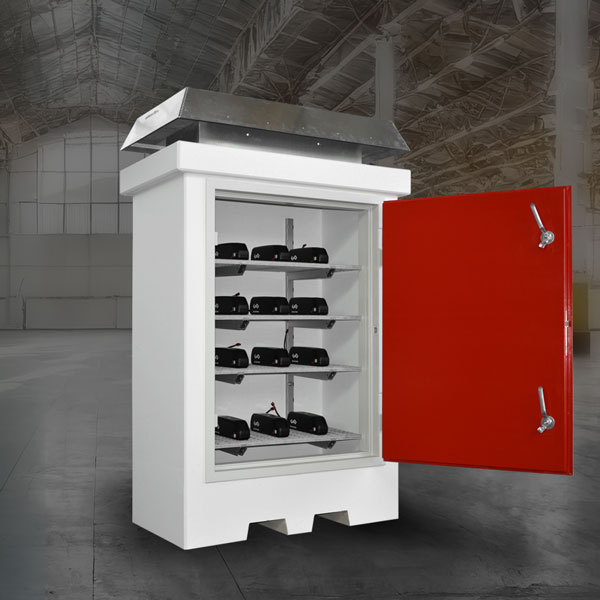
Battery concrete cabinet BBS
Manufactured from precast reinforced concrete elements with a fire resistance rating of F90
- Sturdy concrete cabinet: made of water-impermeable C 35/45 concrete in accordance with EN 206-1, with fire resistance class F90
- T90-1 fire door: DIBt-certified version (BRM 1,100 x 1,600 mm)
- Tested protection in a real-world test: Maximum protection in line with ADR requirements
- Protected by a utility model: Design (DBGM 20 2023101699) for the most demanding requirements in the charging and storage of lithium-ion batteries
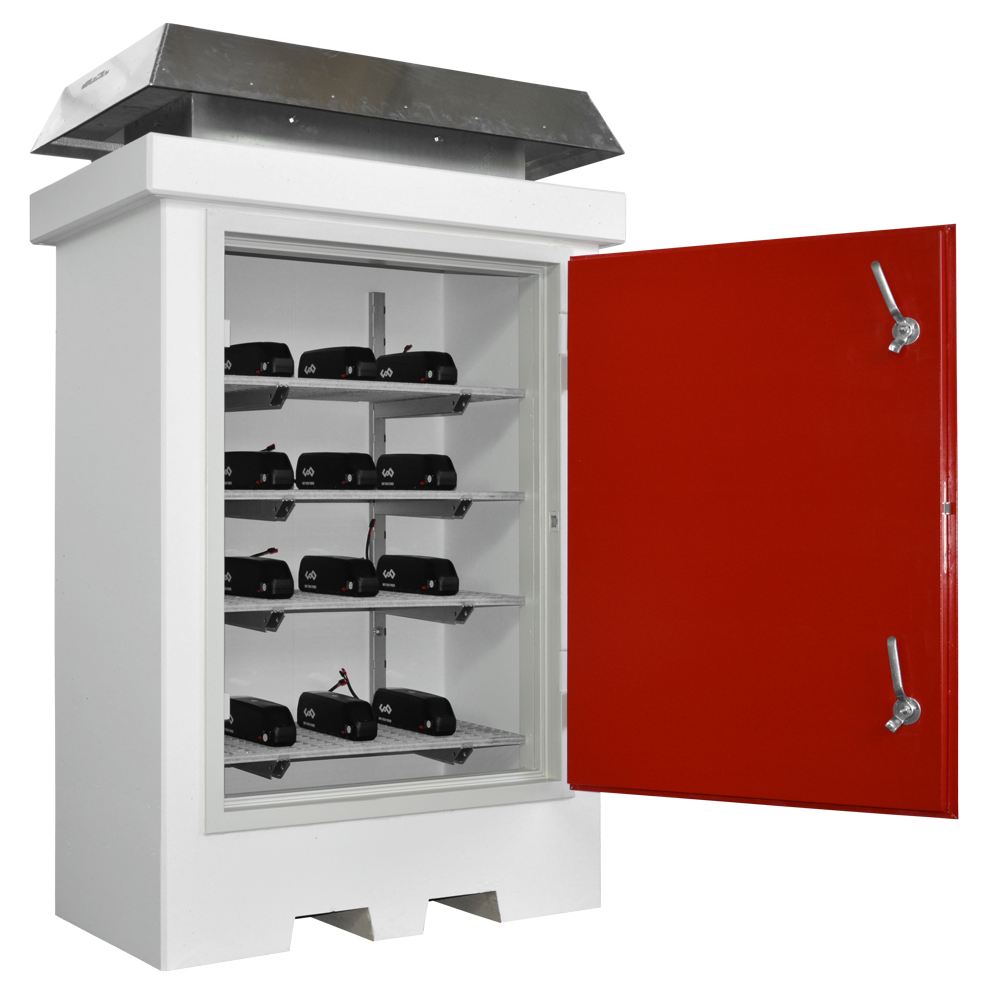
Battery concrete cabinet BBS
Manufactured from precast reinforced concrete elements with a fire resistance rating of F90
- Sturdy concrete cabinet: made of water-impermeable C 35/45 concrete in accordance with EN 206-1, with fire resistance class F90
- T90-1 fire door: DIBt-certified version (BRM 1,100 x 1,600 mm)
- Tested protection in a real-world test: Maximum protection in line with ADR requirements
- Protected by a utility model: Design (DBGM 20 2023101699) for the most demanding requirements in the charging and storage of lithium-ion batteries
Features | The LaCont BBS Battery and Concrete Cabinet
- Concrete cabinet made from precast reinforced concrete elements with a fire resistance rating of F90
- Water-impermeable concrete C 35/45 in accordance with EN 206-1, XC4, XD1, XF1, XA1
- Exposed surfaces are smooth as if formwork-finished; all visible edges are chamfered
- Roof pitch towards the rear wall with a drip edge
- For forklift transport: 2 x 220 x 100 mm access opening for forklift forks
- DBGM 20 2023101699
- T90-1 fire door in accordance with the general building approval issued by the DIBt Berlin
- Lockable with an additional wedge-lever lock
BBS safety and charging accessories
- Pressure relief dome with gas management system, including a fleece mat for filtering harmful gases in the event of an emergency
- VDS-certified LiBa®Sol aerosol fire-extinguishing system
- Charger for charging rechargeable batteries
- T90-1 fire-rated door with additional wedge-lever lock
Overview of certifications for lithium battery cabinets
A direct comparison of the key certification marks and standards under which our lithium-ion battery cabinets are certified
| Model | EN 1363-1 | EN 14470-1 | VDMA 24994 | GS |
|---|---|---|---|---|
| Basic | ✔ | X | X | X |
| Safe Pro | ✔ | ✔ | X | ✔ |
| Premium | X | X | ✔ | X |
| BBS | ✔ | X | X | X |
Our new brochure is available to download
Download the latest brochure Download the guide to safe lithium-ion storage directly as a PDF and keep track of all the technical data.
FAQ – Frequently Asked Questions about battery cabinets
Here you will find answers to frequently asked questions about battery charging cabinets
What is a lithium-ion battery cabinet and what is it used for?
A lithium-ion battery cabinet (also known as a battery safety cabinet or battery charging cabinet) provides a fire-protected environment for the charging and safe storage of lithium-ion batteries. As damaged or faulty batteries pose a significant fire hazard, the cabinet protects the surrounding area from the consequences of a potential battery fire (thermal runaway). Furthermore, the batteries also protected against external fire, so as to prevent any additional hazards caused by batteries catching fire or exploding.
Particularly in the industrial and commercial sectors, such as in production facilities, depots or Certified lithium-ion storage systems are now standard practice not only in logistics companies but also in craft businesses and municipal/local authority organisations (e.g. building yards, road maintenance depots). They ensure that lithium batteries can be charged in a controlled manner and are protected from risks.
Who would benefit from a battery cabinet like this?
A battery cabinet may be required wherever rechargeable batteries are used on a regular basis.
Typical locations include:
-
Industrial and manufacturing companies (e.g. power tools, mobile machinery)
-
Logistics centres and warehouses (e.g. scanners)
-
Bicycle shops and e-bike hire companies
-
Trades businesses and municipal depots (e.g. rechargeable tool batteries or batteries for municipal equipment)
How does a battery charging cabinet provide protection in an emergency?
High-quality security cabinets offer dual protection (internal and external):
-
Fire safety from the inside out: If a battery catches fire inside the cabinet, the casing withstands the flames and heat for a certain period of time (e.g. 90 minutes), preventing the fire from spreading throughout the room
-
Fire safety from the outside in: In the event of an external fire (e.g. a fire in a warehouse), the batteries stored in the cabinet are protected from the external heat or fire, so that they do not cause the fire to spread more rapidly (e.g. through further explosions)
The purpose of fire protection on both sides is to give the emergency services and the fire brigade time to carry out fire-fighting operations and to evacuate people.
What do the terms "F90" or "90 minutes" fire resistance’ mean?
These designations indicate how long (for example, a fire-resistant cabinet) can withstand a fire. F90 means that, in the event of an emergency, the cabinet is resistant to heat and fire for at least 90 minutes. This timeframe is crucial in enabling rescue services and the fire brigade to evacuate the premises and extinguish the fire. A fire resistance rating of 90 minutes is currently regarded as state of the art.
Why are lithium-ion batteries so dangerous, and what causes a battery fire?
Due to their very high energy density, lithium-ion batteries (rechargeable batteries) pose a risk that should not be underestimated. For a wide variety of reasons, rechargeable batteries can catch fire and explode, sometimes with serious consequences.
Due to this high risk and the fact that fires involving lithium-ion batteries (rechargeable batteries) are difficult to extinguish and water can only be used as a coolant, the utmost care must be taken to ensure safety when storing and charging rechargeable batteries.
In practice, such dangerous battery fires are usually caused by five main factors:
- Overheating whilst charging
- Incorrect chargers or overcharging
- Deep discharge
- Mechanical damage
- High ambient temperature
What fire safety requirements must be observed in relation to lithium-ion batteries?
- Compliance with all specifications issued by the respective manufacturers of lithium-ion batteries (rechargeable batteries) and chargers, as well as with the technical product data sheets
- Prevention of external short circuits; protection against short circuits at the battery terminals, e.g. by using terminal caps
- Protection against mechanical damage
- Do not expose lithium-ion batteries (rechargeable batteries) to high temperatures for prolonged periods (e.g. direct sunlight)
- Never charge damaged or faulty batteries
- Dispose of damaged or faulty batteries immediately and in the correct manner
- A minimum distance of 2.5 m or 5 m from other facilities or materials
- Storage of lithium-ion batteries (rechargeable batteries) in a fire-resistant, separate area
- If there are more than 5 batteries, use a charging cabinet (safety cabinet) or a room with fire-resistant partitions
- Disconnect batteries from the mains after charging (do not leave them to charge unattended)
Are there any legal regulations governing the storage of lithium-ion batteries?
To date, there is no valid legislation governing the storage of lithium-ion batteries (rechargeable batteries). Nevertheless, lithium-ion batteries should be treated as hazardous substances. Information sheets, guidelines and publications can serve as a source of guidance and recommendations for action:
VdS 3103: Guideline issued by the Association of German Non-Life Insurers (VdS) containing advice on damage prevention during the storage and handling of lithium-ion batteries (rechargeable batteries) in production and storage areas
Brief information from the GDV: Information from the German Insurance Association (GDV); if there are more than 5 batteries, a charging cabinet or a room with separate fire protection measures must be provided
DGUV Information 205-041: Publication: Fire Safety when Handling Lithium-Ion Batteries (Rechargeable Batteries) by the DGUV (German Social Accident Insurance)
VDMA Standard Sheet 24994:2024-08: Test requirements for fire-resistant storage cabinets for lithium-ion batteries (rechargeable batteries) in the event of thermal runaway, as set out by the VDMA (German Engineering Federation)
TRGS 510,13 – Technical Rules on Hazardous Substances: Separate storage, e.g. by means of walls or cupboards made of non-combustible material, with a fire resistance rating of > 90 minutes
What should be taken into account before putting a battery cabinet into service?
Our recommendation:
- You should contact your insurance provider, the fire service and/or an expert before putting a cabinet into service
- A risk assessment and a comprehensive fire safety plan are essential
- The installation of a fire alarm system, connection to an existing building fire alarm system, and signal transmission – for example, to a control centre via a potential-free contact and/or a fire-extinguishing system – may be required
What additional security features might be useful?
Depending on the model, the battery cabinets are equipped with:
-
Integrated smoke or fire alarms (often involving referral to an external control centre)
-
Automatically locking doors in the event of a fire
-
Mechanical ventilation, to prevent heat build-up whilst charging
-
Integrated fire-extinguishing systems, such as aerosol fire-extinguishing generators, which are triggered automatically in the event of an emergency
Which safety features are ultimately required or necessary is usually determined as part of the risk assessment and following consultation with insurers or fire safety authorities.
What else should be borne in mind when storing or using lithium-ion batteries?
In addition to the use of storage/loading cupboards, the risk assessment must also take into account the Handling the batteries This must be clearly regulated. In particular, the fundamental risk of battery fires can already be significantly minimised by the timely disposal of critical batteries (mechanically defective, technically defective, end-of-life, etc.). In combination with an F90-rated storage cabinet, this ensures a very high level of safety.